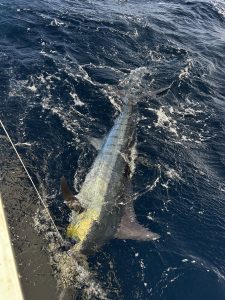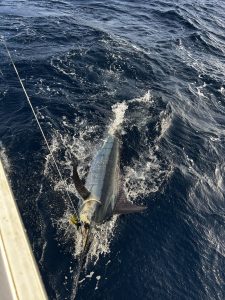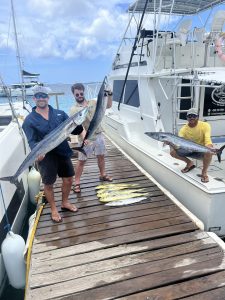
Jigging for yellowfin tuna off Bonaire is hard, honest fishing. You drop a heavy jig deep, work it back up, and when a tuna eats, it tries to pull the rod out of your hands. It happens at the FADs, the fish-aggregating buoys anchored offshore, and the bite is best at first light. Get the yellowfin tuna jigging gear right and you give yourself a real shot. Here is what we actually use.
Yellowfin tuna in Bonaire
Bonaire’s deep water drops away fast, and the FADs concentrate bait and tuna in the blue. Yellowfin are around all year, with peaks when the water and bait line up. There is no closed season, just better and slower weeks. Most fish you jig run from school-size up to solid 45- to 90-pound tuna, and even a “small” one fights like it owes you money. Learn more on our yellowfin tuna species page.
The rod and reel
This is vertical jigging, so you want a parabolic jigging rod matched to a strong spinning reel. A parabolic blank bends through its length, which cushions the headshakes and protects the line when a big tuna sounds. For the reel, go with proven saltwater workhorses:
- Shimano Stella SW or Saragosa, sealed, smooth, and built for this abuse
- Penn Slammer or Penn Authority, tough drags, excellent value, easy to service
Whichever you pick, you want a reel with a strong, smooth drag and a high line capacity. The drag, not the angler, should wear the fish down.
Line and leader
Spool with PE4 to PE6 braid, roughly 50–80 lb. That range gives you the strength to lift a heavy fish off the bottom of its dive without being so thick it kills your jig action. To the braid, tie a length of fluorocarbon leader. Fluoro is abrasion-resistant and far less visible in Bonaire’s clear water, which matters with sharp-eyed tuna. Connect braid to leader with a proper FG knot, take your time on that connection, because it is the weakest link if you rush it.
Lures: vertical jigs and assist hooks
For this depth and these currents, fish 150–250 g vertical jigs rigged with assist hooks. The weight depends on the day: more current or wind means heavier so you stay vertical and keep contact with the jig. Assist hooks set up at the head of the jig hook cleaner and give you a much better hold than trebles, and they are kinder if you release a fish. Carry a few colours and weights, silver and blue-pink earn their keep here. Pick up jigs, assists and leader at TackleDirect so you arrive rigged and ready.
How to fish it
Be at the FADs at first light. That early window is your best chance. Drop the jig to around 500 feet, let it hit the depth where the fish are holding, then work it back up through the water column with a steady jig-and-wind rhythm: lift the rod, drop and reel in the slack, repeat. Vary your speed until you find what triggers them. The eat often comes on the drop or right at the top of a sweep, so stay sharp the whole way up. When a tuna loads the rod, let the parabolic blank and the drag do their job, keep steady pressure, short pumps, and never high-stick a green fish.
Come jig with us
Jigging tuna is a skill, and the fastest way to learn is on the water with someone who does it every day. If you want to put this into practice over Bonaire’s FADs, book a fishing trip and we’ll get the jigs working at first light.
Captain’s note, we jig the FADs a few miles out on PE4–PE6 braid (about 50–80 lb). A yellowfin brought straight up from depth is honest, shoulder-burning work. There is no faking the recovery.
More from the Fishtales tackle & technique series
- The full method → Bonaire game-fish tackle & technique
- The fish → Yellowfin tuna on Bonaire
- See also → Popping & Stickbaiting for Tuna and Jacks in Bonaire · Bottom Fishing & Deep-Dropping in Bonaire: The Gear
- Ready to fish? → Book your trip