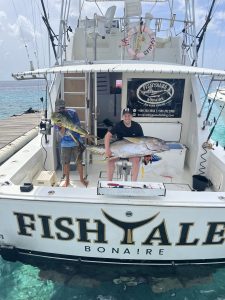
Most places, you burn an hour running offshore before a bait ever gets wet. Bonaire doesn’t fish that way. Two pieces of structure carry this whole program, the wall and the FADs, and once you see how they set up, the rest falls into place. Here’s how we actually work it.
Why Bonaire’s Geography Is Different
Bonaire’s leeward reef wall breaks within about 30 feet of the beach, the same ledge the divers come for, and from there it drops off a cliff. You’re over 1,000 feet of blue water inside a mile of the harbor. The pelagics ride that ledge in tight, so we’re pulling a spread on live water instead of steaming for it. Short run, real estate that holds fish, that’s the edge.
Trolling the Wall
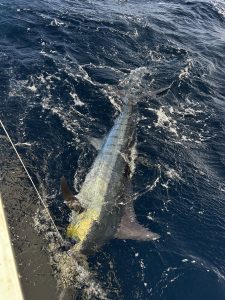
First order of business on most charters is a troll down the dropoff. We run the spread at about 7 knots and work the seam where the reef shelf falls into blue. That color change is the ambush line, and it’s where the headline fish hunt: blue marlin, wahoo, mahi-mahi and sailfish. Trolling covers ground and keeps baits in front of fish that are moving and feeding on that edge. The wall sits in so close that a marlin will light up and crash the spread with the island still on the horizon, that’s the one nobody forgets.
Jigging the FADs for Tuna
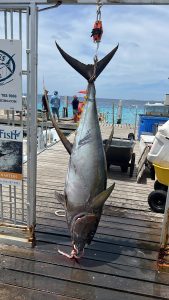
The other half of the day is the FADs, fish-aggregating buoys anchored a few miles out. They stack baitfish, and bait means tuna. We drop jigs to around 500 feet and grind yellowfin up out of the dark. If you’ve never fought a yellowfin straight up from depth, it’s honest work, short pumps, no give, and your shoulders will know about it the next morning. First light is the window; the early trips earn it.
The Two-Method Day
What sets a Bonaire charter apart is that we can do both in one outing. Trolling the wall and jigging the FADs are two different games for two different sets of fish, and the short distances mean we’re not burning the day running between them:
| Method | Where | Target | Best window |
|---|---|---|---|
| Trolling at ~7 knots | Down the reef-wall dropoff | Marlin, wahoo, mahi, sailfish | Through the day |
| Jigging at ~500 feet | The FAD buoys, a few miles out | Yellowfin tuna | First light |
Calm Water on the Leeward Side
All of it leans on the leeward side. Bonaire’s west coast sits in the wind shadow, so the water stays flat, a steadier deck for jigging, cleaner presentations on the troll, and a boat that fishes hard from first light to lines-out. Close deep water and calm conditions in the same place isn’t a combination you find in many ports.
Who It Fishes For
It’s a wide-open fishery. A seasoned angler gets real variety in a single day, billfish on the troll, yellowfin on the jig. Step onto a sportfisher for the first time and you still get a short run, flat water, and a legitimate shot at a big-game fish without paying for it offshore. Same wall, same FADs, the day shapes to what you’re after.
Put It Together on the Water
The wall and the FADs are the whole story here: the reef drops off in tight, the blue water’s right there, and the buoys stack the tuna offshore. Add the calm leeward side and you’ve got a fishery that’s hard to match. Best way to understand it is to fish it, book a fishing trip and we’ll put you on the wall and the FADs and show you exactly how it works. Rates and availability on request. See you at the dock.