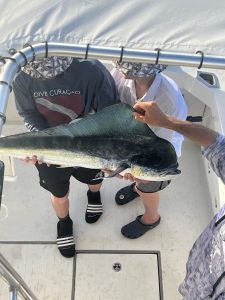
Few fish light up a trip like a mahi-mahi. They are fast, they jump, they turn neon green and gold next to the boat, and they eat well. The good news for anyone wondering how to catch mahi mahi Bonaire style: it is not complicated tackle, it is about finding the fish and putting a lure in front of them at the right moment. Here is how we do it.
Mahi-Mahi in Bonaire
We catch them year-round, with peaks when the water warms and current pushes floating cover our way. Look for life on the surface: weed-lines, drifting debris, a stray pallet or board, and the FADs (fish aggregating devices) offshore. Mahi hold under that shade, and where you find one you usually find a school. Want the full rundown on the species? See our mahi-mahi page.
Rod & Reel
You do not need heavy gear for dorado. Two setups cover almost everything:
- Light-to-medium spinning gear for casting at fish you spot under cover. It is fun, it lets you place a lure precisely, and most Bonaire mahi are well within its limits.
- 20–30 lb trolling tackle for covering water and locating a school in the first place. Conventional reels in this class handle a big bull without ever feeling outgunned.
That is the honest range. Going heavier just kills the sport.
Line & Leader
Mahi-mahi have decent eyesight and gin-clear water works against you, so keep terminal tackle clean. Run a light fluorocarbon leader, enough to handle their teeth and the rubbing during a fight, but light enough that a wary fish still commits. There is no need for wire; that scares more bites than it saves. Tie good knots and check your leader after every fish, because a hard-charging dorado scuffs it fast.
Lures & Bait
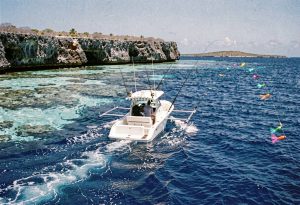
For trolling, small skirted lures and rigged ballyhoo are the workhorses. Run them in a tight spread and watch the spread, not your phone, the bite is often a flash of color before the rod loads. Once you are on a school, switch to casting: a bucktail or a casting jig pitched right at fish holding under the weed-line, debris or a FAD is deadly. The jig sinks into their zone and triggers reaction strikes when a skirt floating on top gets ignored.
Keep a few of each on board. If you need to stock up before a trip, TackleDirect is where you can pick up skirts, ballyhoo, jigs and leader material.
How to Fish It
Here is the trick most people miss. When you hook the first mahi, keep that hooked fish in the water next to the boat. Dorado are social, the rest of the school stays with their hooked buddy, milling and lit up right beside you. That is your window: have crew pitch jigs and bucktails to the followers while one rod stays tight. Done right, a single school turns into a multiple-fish flurry instead of one-and-done. Stay calm, keep lures moving, and do not horse the held fish to the boat too soon.
Ready to Go?
Mahi-mahi reward anglers who hunt structure and fish smart over anglers with the most expensive gear. Bring the right setups, find the floating cover, and work the school. If you would rather skip the guesswork and get straight to the bite, book a fishing trip with us and we will put you on them.
Captain’s note, light tackle is the whole point with mahi; 20–30 lb gear keeps the acrobatics fun and still handles a heavy bull. A circle hook over a rigged ballyhoo and they will eat all day.
More from the Fishtales tackle & technique series
- The full method → Bonaire game-fish tackle & technique
- The fish → Mahi-mahi on Bonaire
- See also → Trolling Tackle for Blue Marlin in Bonaire · How to Catch Wahoo in Bonaire: High-Speed Trolling Gear
- Ready to fish? → Book your trip