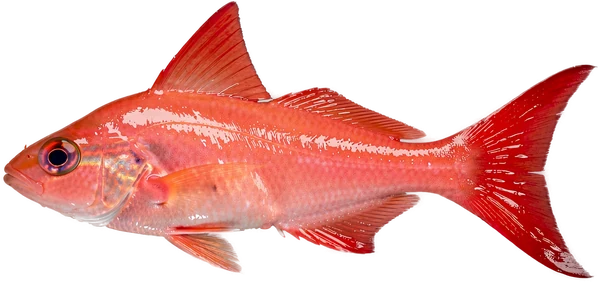
Off the leeward coast of Bonaire, where the reef wall plunges into true blue water, lives one of the prettiest fish you can put in the box: the queen snapper (Etelis oculatus). It is a brilliant rosy-red deep-water snapper with an enormous eye and a long, lyre-shaped forked tail, a creature built for the lightless ledges far below the surface. There is no closed season for it, and because Bonaire’s drop-off sits within about a mile of Kralendijk marina, the deep ledges it calls home are just minutes from the dock.
What the queen snapper is
The queen snapper is a deep-dwelling member of the snapper family, instantly recognisable by its vivid coral-red colouring, that huge dark eye and the streaming forked tail that gives it an almost ribbon-like silhouette. Most fish we bring up run between 5 and 20 lb. Its big eye is the giveaway to where it lives, down in the gloom of the deep reef, where light barely reaches and good eyesight matters. It is also, by reputation, one of the finest-eating fish in the Caribbean, which is exactly why anglers love finding them.
Where to find them on Bonaire
This is where Bonaire’s geography becomes a genuine advantage. The leeward reef wall drops from around 9–10 metres to open ocean within sight of the dock, and true deep blue water of 300 metres and more sits within roughly a mile of the marina. Queen snapper hold along the deep ledges below, broadly in the 200–450 metre range. On many islands you would burn an hour of fuel to reach water like that. Here, lines hit the bottom only minutes after the boat clears the harbour, so a single trip can mix trolling the surface with dropping deep, minimal dead running time, maximum fishing.
Best season for queen snapper
The good news is that the queen snapper bites year-round. Bonaire’s sea temperature holds a steady 26–28°C through every month, and the deep ledges stay productive regardless of the calendar. The deciding factor is rarely the season and more often the day’s wind and current: when conditions favour working the bottom, deep-dropping for snapper becomes the smart play, while other days lean toward trolling the blue. Your captain reads it on the morning and chooses the technique that is fishing best.
How we fish for queen snapper
Queen snapper is a deep-drop fish. When we switch from trolling the dropoff, we send heavy baited rigs straight down to the deep ledges on stout tackle built to work water hundreds of metres below. There is no casting and no chasing. It is precise, patient fishing where you feel the bottom, wait for the lean of a take, and then bring the weight up steadily through the current. Every Fishtales trip is a private charter for a maximum of six anglers, and tackle, bait, lures and drinks are all included, so you step aboard and simply fish.
The fight and the experience
This is not the explosive aerial hunt of a billfish, the queen snapper’s drama is all in the depths. You will feel strong, steady, heavy pulls as the fish digs in against the current far below, a slow tug-of-war that loads the rod and tests your arms more than your nerve. Then comes the moment that makes deep-dropping addictive: that flash of impossible rose-red rising out of the dark blue, getting brighter as it nears the boat. For many guests it is the most beautiful fish of the day.
Keep it for the table
Unlike the marlin and sailfish we always catch-photo-release, the queen snapper is an edible species and one of the best of them all. Its clean white flesh is prized in kitchens across the Caribbean, so this is a fish we are happy to keep for the table. We take only what is good to eat and leave the rest of the deep reef as we found it, your dinner, caught that morning a mile from shore.
Book your Bonaire queen snapper trip
Want to add some rose-red deep-water gold to your day on the water? Book your private Fishtales charter and we will mix trolling the blue with deep-dropping the ledges. While you are here, look at the red snapper, another superb deep-water table fish, and the hard-pulling amberjack that haunts the same deep structure.