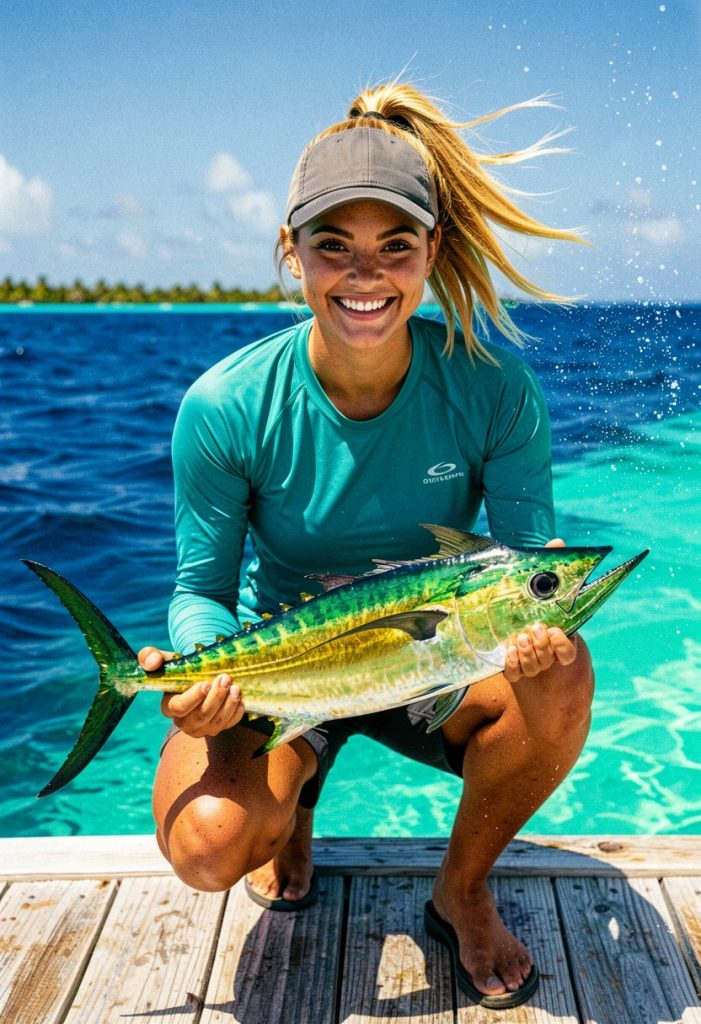
Few fish announce themselves like the mahi mahi. One second the deep blue is empty, the next a slab of electric green and gold lights up behind the spread, scything across the surface. On Bonaire they call it dradu and from the moment it eats it never stops moving. Acrobatic, fast and ferocious, the mahi mahi (Coryphaena hippurus) is the fish that turns a quiet troll into chaos in a heartbeat.
What it is
The mahi mahi is a pelagic showman built for speed and open water. Its colours are almost unreal: vivid green flanks, gold along the body, flecks of electric blue, all of it pulsing brighter when the fish is hot. Most run a respectable 15 to 30 lb here, but the bigger bulls push 40 to 60 lb, blunt-headed and broad-shouldered. They grow fast, fight hard and feed aggressively, which makes them one of the most exciting fish you can hook off Bonaire.
Where on Bonaire we find them
Dradu live over deep blue water and on Bonaire that water is close. The leeward reef wall drops away within ten metres of shore, so true blue lies barely a mile from the dock. Mahi mahi hold to structure on that open water: weed-lines, floating debris and especially the FADs a few miles out. Anything adrift in the blue is a magnet. Find the floating object and you have often found the fish, sometimes in a pack lit up and looking for a fight.
Best season for mahi mahi
Bonaire fishes year-round and mahi mahi are no exception. Sea temperatures sit at a steady 26 to 28C through every month, so dradu are always a possibility. The peak runs roughly October to April, with the biggest fish stacking up between October and January. Plan a winter trip and you tilt the odds toward a true bull. Come any other month and there is still every chance of green and gold in the spread.
How we fish it
We start working minutes after leaving Kralendijk. Trolling runs go at around 7 knots along the dropoff and out toward the FADs, lures skipping behind the boat in the blue. When we spot floating structure or raise a fish, the game changes: we cast to it, pitch baits and watch the school light up and charge. The take is violent and instant. Tackle, bait and drinks are all included, so you step aboard and simply fish.
The fight
Hook a dradu and hold on. The first run is searing and then it goes vertical, throwing itself clear of the water in a blur of colour, tail-walking and greyhounding across the surface. They change direction without warning and rarely give up until they are at the boat. For a crew of up to six anglers it is pure theatre, the kind of fight people fly across the world for. No two mahi mahi behave the same and that unpredictability is exactly the thrill.
Eat or conserve
Here the answer is easy: mahi mahi is one of the best eating fish in the sea. Firm, clean white fillets, mild and sweet, they are superb on the grill within hours of being landed. Fast-growing and abundant, dradu are a fish you can keep with a clear conscience and a good appetite. Few trips end better than fresh mahi cooked the same evening.
Book your mahi mahi trip
Want to watch the blue light up green and gold behind the boat? Bonaire’s deep water starts minutes from the marina and dradu are waiting. Book your fishing trip with us, then read up on the speed-demon wahoo and the high-flying sailfish while you plan your day on the water. Tackle, bait and drinks included, six anglers max, departing Kralendijk.